

The Equine Carpus

Learning Outcomes
By the end of this article, you should be able to:
Describe the anatomical structure of the equine carpus, including the bones and joints that comprise it.
Explain the function of the carpus during weight bearing and locomotion.
Recognise the importance of the carpus in maintaining limb stability and identify common clinical conditions affecting this region.
Definition
The equine carpus, commonly referred to as the knee, is a complex synovial joint located between the radius and the metacarpus of the forelimb. It is composed of multiple small carpal bones arranged in two rows, forming a series of articulations that provide strength, flexibility and shock absorption. Although commonly called the knee, it is anatomically equivalent to the human wrist. The carpus plays a vital role in supporting the horse's body weight, absorbing concussion during locomotion and allowing controlled flexion of the forelimb. Due to the substantial forces transmitted through this region during athletic activity, the carpus is frequently affected by traumatic injuries and degenerative joint disease.
Prefer an audio version? Listen here:
Origin
Embryologically, the carpus develops through endochondral ossification, whereby cartilage models are gradually replaced by bone. During foetal development, individual carpal bones form separate centres of ossification before fusing into mature structures. In the adult horse, the carpus forms the articulation between the distal radius proximally and the third metacarpal bone distally, with additional support from the second and fourth metacarpal bones. Numerous ligaments, tendons and joint capsules stabilise the carpus while permitting the controlled movement necessary for efficient locomotion.
Anatomy
The equine carpus consists of seven or eight short bones arranged in two rows.
The proximal row comprises the radial, intermediate, ulnar and accessory carpal bones. In many horses the radial and intermediate carpal bones are fused, resulting in a total of seven carpal bones rather than eight. The accessory carpal bone projects caudally and acts as an important lever arm for the flexor muscles and tendons.
The distal row consists of the first (occasionally absent), second, third and fourth carpal bones. The third carpal bone is the largest of the distal row and bears a significant proportion of the compressive forces transmitted through the limb.
These bones form three principal joints:
The antebrachiocarpal (radiocarpal) joint between the radius and proximal carpal row.
The middle carpal joint between the proximal and distal rows.
The carpometacarpal joint between the distal carpal bones and metacarpal bones.
The antebrachiocarpal and middle carpal joints contribute most of the movement within the carpus, while the carpometacarpal joint has minimal movement and primarily provides stability.

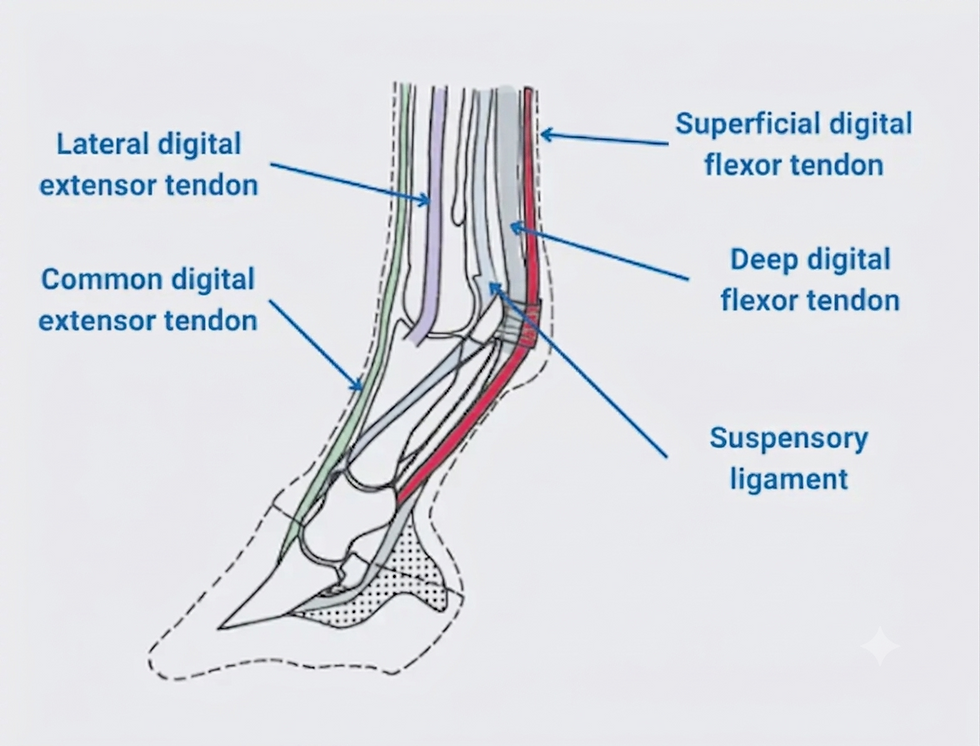
The carpus is reinforced by strong medial and lateral collateral ligaments, dorsal and palmar carpal ligaments and the palmar carpal fibrocartilage, which resists hyperextension. Numerous tendons pass over the carpus, including the common digital extensor tendon dorsally and the superficial and deep digital flexor tendons on the palmar aspect. These tendons are retained close to the bones by extensor and flexor retinacula, preventing bowstringing during movement.
Function
The primary function of the carpus is to permit controlled flexion while maintaining stability under considerable loading. During locomotion, it acts as a shock absorber, dissipating forces generated when the hoof contacts the ground. At faster gaits such as the canter and gallop, the carpus undergoes substantial extension during weight bearing before flexing rapidly during the swing phase to allow limb advancement.
The carpus also contributes to efficient energy transfer through the limb by coordinating movement between the radius and metacarpus. Its multiple articulations distribute compressive forces across several joints, reducing stress on individual bones and helping protect surrounding soft tissues.
For the farrier, maintaining correct hoof balance is essential to minimise uneven loading of the carpus. Poor mediolateral or dorsopalmar balance can alter limb biomechanics, increasing stress on the collateral ligaments, carpal joints and associated tendons. Repetitive overloading may contribute to conditions such as osteoarthritis, carpal chip fractures and carpal bone sclerosis, particularly in performance horses.
Clinically, the carpus is one of the most frequently injured joints in racehorses and other equine athletes due to the high compressive and shear forces experienced during fast work. Common conditions include osteoarthritis, chip fractures, slab fractures, collateral ligament injuries and septic arthritis. Diagnosis typically involves lameness examination, diagnostic analgesia and imaging techniques such as radiography, ultrasonography, computed tomography (CT) or magnetic resonance imaging (MRI).
Conclusion
The equine carpus is a complex synovial joint composed of multiple articulations that provide a balance between mobility and stability. Its unique arrangement of carpal bones, ligaments and tendons enables efficient shock absorption and controlled movement during locomotion while supporting the considerable forces generated during athletic activity. An understanding of the anatomy and function of the carpus is fundamental for farriers, as correct hoof balance plays a significant role in maintaining carpal health and reducing the risk of injury. Knowledge of this region also assists in recognising lameness, understanding disease processes and supporting appropriate farriery and veterinary management.
Learning Questions
How many carpal bones are typically present in the equine carpus, and how are they arranged?
Name the three principal joints that make up the equine carpus.
What is the primary function of the accessory carpal bone?
How does the carpus contribute to shock absorption during locomotion?
Why is correct hoof balance important for maintaining the health and function of the equine carpus?


Comments